

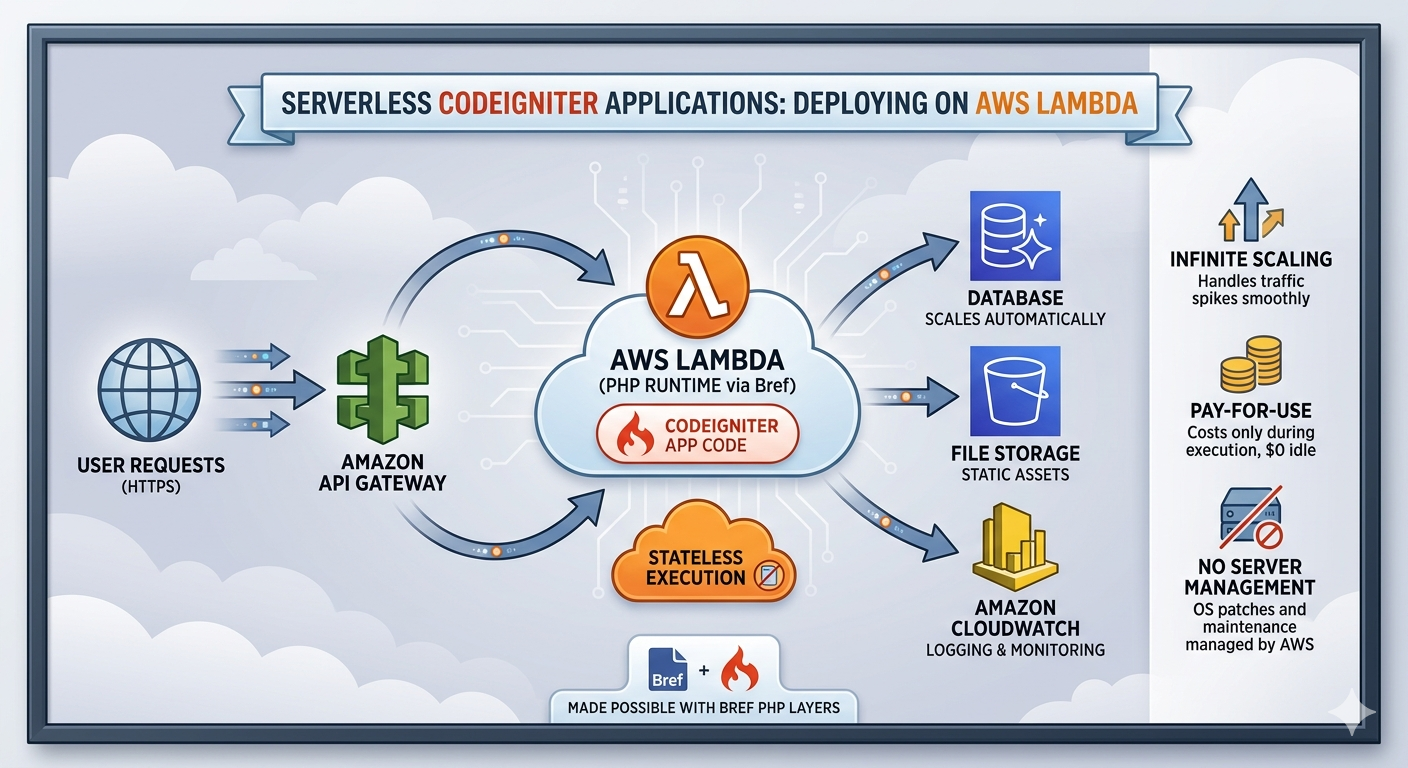
Serverless CodeIgniter Applications: Deploying CodeIgniter Apps Using Serverless Platforms like AWS Lambda
Modern web development is increasingly moving toward scalable, flexible, and cost-efficient architectures. One of the most popular trends in cloud computing today is serverless architecture. With serverless technology, developers can deploy applications without managing servers or infrastructure. By combining CodeIgniter with serverless platforms such as AWS Lambda on Amazon Web Services, developers can build highly scalable and efficient web applications.
In this blog, we will explore how serverless architecture works and how you can deploy CodeIgniter applications using AWS Lambda.
What is Serverless Architecture?
Serverless architecture is a cloud computing model where the cloud provider manages server infrastructure, scaling, and maintenance. Developers simply upload their application code, and the platform automatically runs it when needed.
Services like AWS Lambda execute code in response to events such as HTTP requests, file uploads, or database changes. This means your application runs only when required, helping reduce infrastructure costs and improving efficiency.
Why Use CodeIgniter with Serverless Platforms?
CodeIgniter is a lightweight PHP framework known for its speed and simplicity. When deployed in a serverless environment, it becomes even more powerful.
1. Automatic Scaling
Serverless platforms automatically scale your application based on incoming traffic. This ensures your website performs well even during high traffic periods.
2. Cost Efficiency
Unlike traditional servers that run continuously, serverless platforms charge only for the actual execution time of your application.
3. Reduced Server Management
Cloud providers such as Amazon Web Services handle server provisioning, updates, and maintenance.
4. Faster Deployment
Developers can deploy updates quickly without worrying about server configurations.
Key AWS Services Used for Serverless CodeIgniter Applications
To deploy a serverless CodeIgniter application, several services from Amazon Web Services are typically used:
1. AWS Lambda
Runs your application code in a serverless environment and automatically scales based on demand.
2. Amazon API Gateway
Acts as a gateway that handles HTTP requests and routes them to your Lambda functions.
3. Amazon S3
Stores static files such as images, CSS, JavaScript, and media assets.
4. Amazon RDS
Provides managed relational databases such as MySQL or PostgreSQL for storing application data.
Steps to Deploy CodeIgniter on AWS Lambda
1. Prepare the CodeIgniter Application
Ensure your CodeIgniter project is optimized for production. Remove unnecessary dependencies and configure environment variables.
2. Use a PHP Runtime for Lambda
Since AWS Lambda does not natively support PHP frameworks, developers often use Bref, which enables PHP applications to run on Lambda.
3. Configure the Serverless Framework
Using Serverless Framework, developers can define deployment settings, routes, and functions in a configuration file.
4. Deploy the Application
Deploy your application to AWS Lambda and configure Amazon API Gateway to handle incoming web requests.
5. Connect the Database
Configure your application to connect to Amazon RDS or another database service to store and retrieve data.
Best Practices for Serverless CodeIgniter Applications
Optimize Application Size
Keep the deployment package small to reduce startup time and improve performance.
Use Cloud Storage for Assets
Store images and static files in Amazon S3 instead of including them in the application bundle.
Enable Logging and Monitoring
Use Amazon CloudWatch to monitor logs, errors, and performance metrics.
Implement Caching
Using caching strategies can reduce database queries and improve response time.
Challenges of Serverless Deployment
While serverless architecture provides many benefits, developers may encounter some challenges:
- Cold start latency when functions are inactive
- Additional configuration for PHP environments
- Complexity in debugging distributed systems
However, with proper architecture and monitoring, these challenges can be managed effectively.
Conclusion
Serverless architecture is transforming modern web development by removing the need to manage servers and infrastructure. Deploying CodeIgniter applications using AWS Lambda on Amazon Web Services allows developers to build scalable, cost-efficient, and high-performance applications.
As cloud technologies continue to evolve, serverless solutions are becoming a powerful option for building modern PHP applications and websites. Businesses looking to scale their applications efficiently should consider adopting serverless deployment strategies for their CodeIgniter projects.